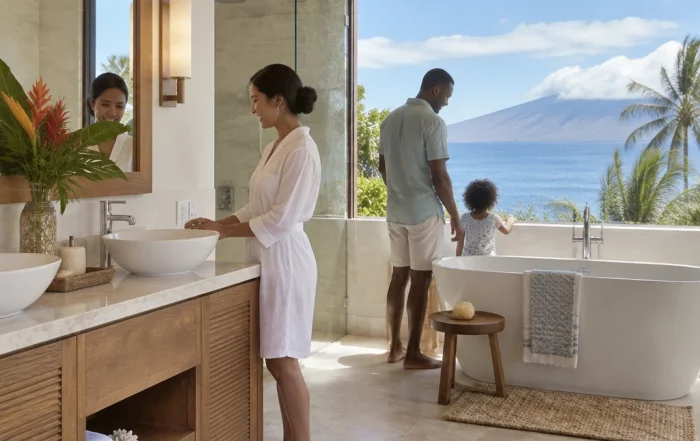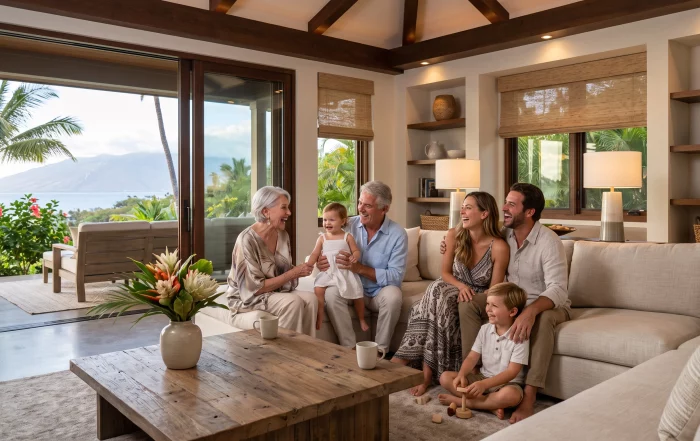
You bought or built your Maui home because you never want to leave — and honestly, why would you? But the home that suits you at 55 may fight you at 75: slippery tile after a swim, deep-seated sofas that are hard to rise from, dim lighting that strains aging eyes. The good news is that aging in place design Maui homeowners actually love doesn’t look clinical or institutional. Done well, it looks like an elegant, light-filled island home that just happens to work beautifully for every stage of life. In this article, you’ll learn what aging in place really means in a Hawaii context, the key design decisions that matter most, how furniture selection plays a bigger role than most people realize, and how a professional design process pulls it all together. Whether you’re renovating your forever home or furnishing a new one from scratch, these principles will help you invest once — wisely — instead of retrofitting in a hurry later.
What Aging in Place Design Means for Maui Homes
On the mainland, aging in place design often centers on cold-weather concerns and enclosed floor plans. Here, aging in place design Maui style has to account for something wonderful and challenging at once: we live indoors and outdoors all year. That means thresholds to lanais, pool decks, and garden paths matter as much as hallways and bathrooms. Salt air, humidity, and intense equatorial sun also degrade materials faster than mainland guides assume, so durability and accessibility have to be planned together.
At its heart, aging in place is simple: design the home so you can live safely, comfortably, and independently for decades — without it ever looking like a medical facility. The best time to do it is now, while you’re planning a renovation or furnishing a new home, not after a fall or a diagnosis forces rushed decisions.
The Indoor-Outdoor Factor
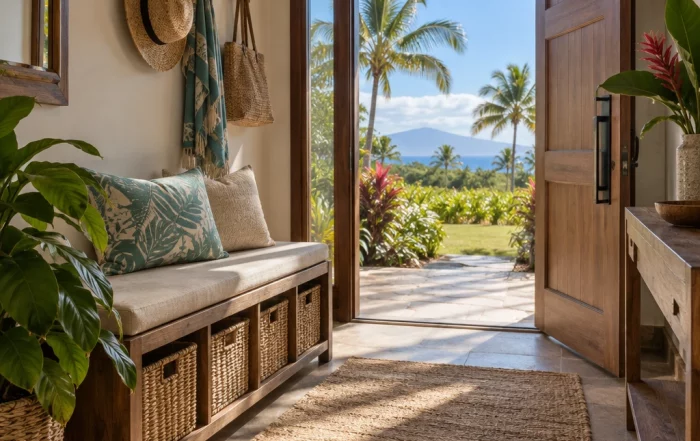
Smooth, flush transitions between interior floors and lanai surfaces eliminate one of the most common trip hazards in island homes. Choosing slip-resistant flooring that performs when wet — because in Hawaii, floors will get wet — is one of the highest-value decisions you can make.
The Core Elements of Accessible Home Design Hawaii Homeowners Should Prioritize
Thoughtful accessible home design Hawaii residents can rely on for the long haul comes down to a handful of decisions made early. Here are the ones that deliver the most impact:
- Wider doorways and clear pathways — at least 36 inches where possible, with furniture layouts that leave generous circulation room
- Curbless showers with built-in seating — a beautiful spa feature today, an essential one tomorrow
- Blocking for future grab bars — installed inside walls during renovation so elegant bars can be added later without demolition
- Lever-style door hardware — easier on arthritic hands than knobs, and available in finishes that resist salt-air corrosion
- Layered lighting — ambient, task, and accent lighting that compensates for aging eyes, especially important given how dramatically Hawaii’s strong natural light shifts to darkness at sunset
- Slip-resistant, low-glare flooring — matte finishes reduce the harsh glare our proximity to the equator creates indoors
Lighting Deserves Special Attention
By age 60, most people need roughly three times more light to see comfortably than they did at 20. In Hawaii, where brilliant daylight pours in and then vanishes quickly after sunset, a well-designed lighting plan — dimmable layers, illuminated pathways to bathrooms, glare control — is both a safety feature and a nightly pleasure.
Furniture Choices That Support You for Decades
Here’s what many aging-in-place guides miss entirely: your furniture matters as much as your floor plan. A stunning sectional you sink into at 50 can become genuinely difficult to exit at 70.
Look for seating with firm cushions, seat heights around 18 to 20 inches, and sturdy arms that support you as you rise. Quality manufacturers like Bernhardt, Hancock & Moore, and Century offer pieces that combine that support with genuinely beautiful design — and many can be customized with the seat height, cushion firmness, arm style, and performance fabrics your situation calls for. Custom orders typically take 8 to 12 weeks, which is a small wait for furniture built to serve you for twenty years.
Performance fabrics deserve special mention in Hawaii. They resist the fading, mildew, and wear that salt air and UV exposure accelerate, and they clean easily — practical for grandchildren’s visits and everyday island living alike. Rounded corners on cocktail and side tables, stable dining chairs with arms, and beds at an easy transfer height round out the picture. None of these choices sacrifice style; they simply add intelligence to it.
Don’t Forget the Lanai
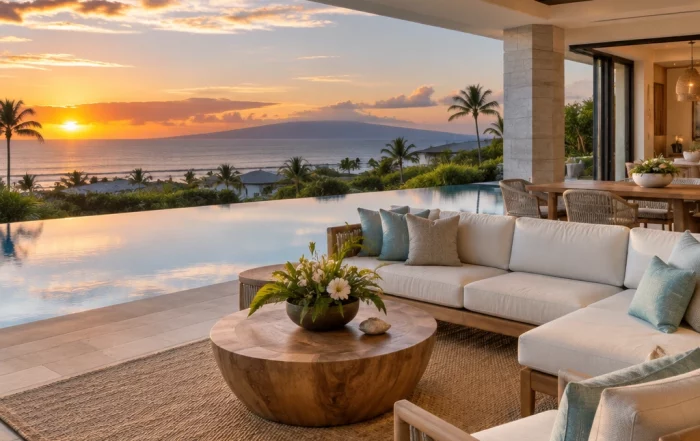
Since Maui living flows outdoors, your lanai furniture needs the same scrutiny: supportive seating, weather-resistant materials from lines like Janus et Cie, and layouts with clear, generous walkways between zones.
How a Maui Interior Designer Approaches Aging in Place
Working with a Maui interior designer aging in place expertise makes the difference between a home that merely accommodates you and one that celebrates how you live. At IDS Maui, we’ve spent 27 years designing for Hawaii’s specific climate and lifestyle, and aging-in-place and wellness design are core specialties — not afterthoughts.
Consider a common scenario: a couple furnishing their forever home upcountry wants a primary suite that works for the next thirty years. The plan might include a curbless shower with a teak bench, blocking behind the walls for future grab bars, lever hardware throughout, a bed at ideal transfer height with custom bedding in breathable, easy-care fabrics, layered dimmable lighting, and a reading chair with firm support and elegant lines. Every element is beautiful today and functional for decades.
Because we work through a structured six-phase process — from programming through purchasing, shipping, and installation — accessibility gets built into the drawings and specifications from day one. We also manage all freight and damage claims, which matters enormously when furnishing a Hawaii home, and we work smoothly alongside your own contractor if you already have one.
Design Your Forever Home in Paradise — Starting Now
Aging in place isn’t about planning for decline; it’s about planning for freedom — the freedom to stay in the home and on the island you love, comfortably and safely, for as long as you choose. The smartest moves are the early ones: flush thresholds, layered lighting, supportive furniture in performance fabrics, and a floor plan with room to move.
If you’re renovating, furnishing a new Maui home, or simply rethinking a room or two, we’d love to help you get it right the first time. Visit the IDS Maui showroom at 3031 Old Haleakala Hwy in Makawao, Monday through Friday from 10 to 6, or call us at 808-891-8800 to talk through your project. From a single bedroom to a whole-home design, our team — led by ASID designer Valorie Spence — brings nearly three decades of Hawaii-specific expertise to homes you’ll love living in for decades to come. Paradise is worth planning for. Let’s design yours to last.
Need Help With Your Space?
Ask us anything — furniture, design, or where to start.