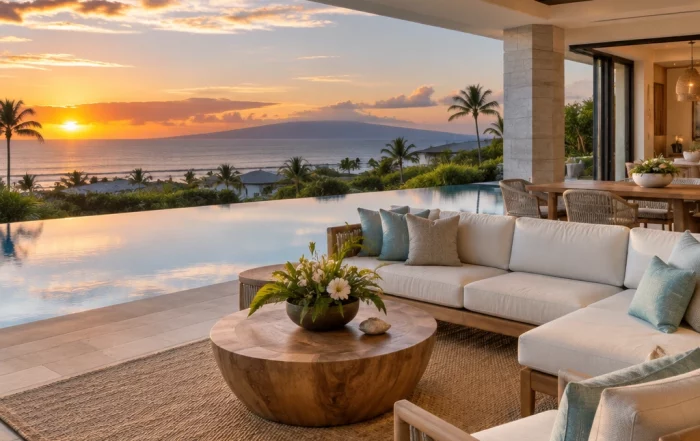
In Maui, the line between indoor and outdoor living doesn’t just blur—it disappears entirely. Your lanai isn’t simply a porch or patio; it’s a dining room at breakfast, a living room by afternoon, and an entertainment space come sunset. Yet treating this essential space like a true room requires more than wishful thinking. It demands furniture and fabrics engineered to withstand salt air, intense UV exposure, and the constant humidity that defines Hawaii’s climate. After 27 years of designing homes across Maui, Lanai, Molokai, and beyond, we’ve learned exactly what survives—and what fails—when your lanai becomes the heart of daily life.
This guide will walk you through the essential considerations for creating a lanai that functions as beautifully as your interior rooms while standing up to the unique challenges of Maui’s indoor-outdoor life. From selecting the right furniture materials to choosing performance fabrics that won’t fade or mildew, you’ll discover how to design a space that truly lives like a room.
Why Maui Lanai Furniture Demands a Different Approach
The same sofa that performs flawlessly in a Seattle living room will deteriorate rapidly on a Maui lanai. Our proximity to the equator intensifies UV radiation, causing fabrics to fade in months rather than years. Salt air doesn’t just affect beachfront properties—trade winds carry corrosive salt particles miles inland, attacking metal hardware, wood finishes, and fabric fibers with relentless consistency.
Humidity presents another challenge mainland designers rarely encounter. Morning dew settles on cushions. Afternoon rain showers blow sideways under covered lanais. Without proper material selection, you’ll face mildew, warping, and rust within the first year. This is precisely why generic outdoor furniture from big-box retailers disappoints Maui homeowners—it’s engineered for occasional use in temperate climates, not for daily life in a tropical environment.
At Interior Design Solutions, we work exclusively with manufacturers who understand these demands. Lines like Janus et Cie and McGuire don’t just create beautiful outdoor furniture—they engineer pieces specifically for the challenges of coastal and tropical climates. These aren’t compromises; they’re investments in furniture that will look stunning five years from now, not just five months.
Materials That Thrive in Hawaii’s Climate
Frame Construction: Beyond Standard Outdoor Aluminum
While powder-coated aluminum works adequately for mainland patios, Maui lanai furniture benefits from more sophisticated approaches. Marine-grade aluminum with multiple protective coatings resists salt corrosion far better than standard finishes. Synthetic wicker woven over aluminum frames combines durability with the organic aesthetic that complements island architecture.
Teak remains the gold standard for wood furniture in Hawaii, but not all teak performs equally. Grade-A teak contains natural oils that repel moisture and resist insects. Lesser grades lack these protective oils and require constant maintenance. McGuire’s rattan and cane pieces, when properly treated, also excel in our climate—their natural flexibility accommodates humidity changes without cracking.
Performance Fabrics That Actually Perform
The revolution in outdoor fabrics over the past decade has transformed lanai design. Today’s performance fabrics from manufacturers like Sunbrella and Perennials offer genuine comfort—not the plasticky feel of older outdoor textiles—while delivering remarkable durability.
Look for these specific characteristics in performance fabric for your Maui lanai:
- Solution-dyed acrylic fibers where color is locked into the fiber itself, not applied as a surface treatment that fades
- Antimicrobial treatments that prevent mildew growth in humid conditions
- Quick-dry foam cores in cushions that shed water and dry rapidly after rain
- UV stability ratings of 1,000+ hours, indicating resistance to our intense equatorial sunlight
- Easy-clean finishes that allow spills to bead up rather than penetrate fibers
We’ve specified custom cushions using these advanced fabrics for countless Maui lanais, and the difference is remarkable. Clients report cushions that still look fresh after five years of daily use—something impossible with standard outdoor fabrics or, worse, indoor upholstery exposed to the elements.
Designing Your Lanai Layout Like an Interior Room
Once you’ve selected materials that will survive Maui’s climate, the design process mirrors interior room planning. We approach lanai layouts using the same principles that guide living room design: conversation groupings, traffic flow, focal points, and proper scale.
Start by defining zones within your lanai space. A dining area needs adequate clearance around the table—at least 36 inches for chair movement. A lounging zone benefits from a sectional or sofa arrangement that encourages conversation, positioned around a cocktail table at the proper height. If your lanai serves multiple functions, area rugs designed for outdoor use can visually separate these zones while adding warmth underfoot.
Lighting transforms a lanai from daytime space to evening retreat. Layer your lighting just as you would indoors: ambient fixtures for overall illumination, task lighting for dining or reading areas, and accent lighting to highlight architectural features or plantings. Coastal-rated fixtures resist corrosion, and LED technology has made outdoor lighting both energy-efficient and long-lasting.
Don’t overlook the ceiling plane. Fans rated for damp or wet locations improve comfort during Maui’s warmer months while adding visual interest. We often specify fans from manufacturers who offer marine-grade finishes and sealed motors that won’t fail in humid conditions.
Real-World Maui Lanai Transformations
One recent project in Wailea perfectly illustrates these principles in action. The homeowners wanted their 400-square-foot lanai to function as their primary living space, hosting everything from morning coffee to evening entertaining. We designed the space around a Janus et Cie sectional in a rich terracotta performance fabric that complements the home’s warm wood tones while standing up to daily use.
The dining area features a custom teak table that seats eight, surrounded by armchairs with quick-dry cushions in a coordinating neutral. Overhead, a marine-grade fan circulates air without corroding in the salt-laden breeze. An outdoor rug from our Phillips Collection line defines the lounging zone, while coastal-rated pendant lights provide ambient evening illumination.
Three years later, the space looks virtually unchanged despite daily use and exposure to Maui’s elements. The performance fabrics show no fading, the teak has developed a beautiful silver patina, and the aluminum frames remain corrosion-free. More importantly, the family uses this lanai exactly as intended—as their true living room, not a space reserved for special occasions.
Creating Your Perfect Maui Lanai
Designing a lanai that lives like a room requires expertise in both interior design principles and Hawaii-specific material science. It’s not simply about selecting attractive furniture—it’s about understanding how our unique climate affects every material, finish, and fabric you specify.
At Interior Design Solutions, we’ve spent 27 years perfecting this balance. Our relationships with manufacturers like Janus et Cie, McGuire, and other premium lines give you access to furniture designed for exactly these conditions, often unavailable elsewhere on Maui. We manage the entire process, from AutoCAD layouts that optimize your lanai’s flow to custom fabric selection that reflects your style while delivering the performance Hawaii demands.
Whether you’re furnishing a compact lanai or designing an expansive outdoor living area, we’d welcome the opportunity to bring our Hawaii-specific expertise to your project. Visit our Makawao showroom at 3031 Old Haleakala Highway, Monday through Friday from 10 to 6, or call us at 808-891-8800 to discuss your lanai vision. Let’s create an outdoor space that truly lives like your favorite room—beautiful today and built to stay that way for years to come.
Need Help With Your Space?
Ask us anything — furniture, design, or where to start.