For homeowners returning to Lahaina, furnishing a rebuilt house is about far more than replacing a sofa. The Maui wildfire rebuild furniture 2026 conversation now includes resilience, lead times, indoor-outdoor living, insurance documentation, and the emotional work of making a house feel like home again. As rebuilding accelerates, owners are asking better questions: Which materials can handle Maui’s sun and salt air? How can a floor plan support changing family needs? Which pieces should be ordered early, and which can be sourced quickly?
Maui County reported substantial recovery progress in 2026, including more than 456 completed residential and multifamily units in Lahaina Town, approximately 300 active construction sites, and an average wildfire permit approval time of 44 days. Yet rebuilding remains personal and complex. A newly completed home still needs lighting, rugs, case goods, dining furniture, outdoor pieces, window treatments, and accessories that reflect the owner’s life and the character of West Maui.
This guide explains what changed in post-fire home furnishing on Maui—and how thoughtful furniture planning can help homeowners, vacation-rental owners, and second-home buyers create interiors that are durable, beautiful, and distinctly Hawaiian.
Maui Furniture After Wildfire Rebuild: The 2026 Shift Toward Resilience
The most important change is that furniture is being selected earlier and more strategically. Before the fires, many clients could approach furnishing as a final decorating step. In 2026, furniture decisions are increasingly part of the rebuild plan itself. Room dimensions, electrical locations, door swings, built-in cabinetry, lanai access, and ceiling heights all affect what will ultimately fit and function.
Maui County’s recovery process has also become more structured. The County’s official building-permit guidance identifies a dedicated disaster-recovery pathway for properties affected by the 2023 wildfires, including pre-approval options for single-family dwelling plans and factory-built housing in the Lahaina burn zone. That means homeowners should begin interior planning while construction documents and finish selections are still being coordinated—not after the keys are handed over.
For a fire-damaged home interior design Lahaina project, the practical sequence often looks like this:
- Confirm the rebuilt home’s measurements, openings, ceiling heights, and electrical plan.
- Prioritize pieces with long manufacturing or shipping timelines.
- Choose fabrics, finishes, rugs, and woods for Maui’s sun, humidity, wind, and salt exposure.
- Coordinate furniture with lighting, flooring, paint colors, plumbing fixtures, and cabinetry.
- Reserve delivery, receiving, inspection, and installation time well before occupancy.
At IDS Maui, made-to-order furniture can often be customized by dimension, leg style, arm profile, finish, cushion, and fabric. Standard made-to-order pieces may take up to eight weeks, while Quick Ship items can arrive in approximately two to three weeks, subject to manufacturer availability and freight scheduling. Planning early helps prevent an otherwise finished house from sitting empty for months.
Designing for recovery, not just replacement
Replacing what was lost is understandable, but a rebuild also offers an opportunity to rethink circulation, storage, accessibility, and daily routines. A rebuilt primary suite may benefit from wider clearances, a comfortable reading chair, layered lighting, and nightstands with accessible outlets. A family room may need durable performance upholstery, flexible seating, and concealed storage rather than a single oversized sectional.
These decisions are especially valuable for multigenerational households, aging-in-place needs, and vacation homes that must perform reliably between visits. Resilient furniture choices Maui homeowners make today should support the next decade—not simply recreate the previous room.
What Rebuilding Progress Means for Furniture Planning in Lahaina
Recovery statistics show why furniture planning needs to be coordinated with construction rather than delayed until the end. In December 2025, Maui County announced completion of the 100th structure in the wildfire-affected areas. At that point, the expedited process had issued 629 permits, including 579 residential rebuilding permits in the Lahaina burn zone. The County defined a completed permit as a structure that had passed final inspection and was ready to be inhabited.
By 2026, the County’s State of the County address reported 151 completed permits, 552 approved permits, and 336 additional permits in the pipeline. Those figures represent momentum, but they also indicate that homes are reaching completion at different times. Some owners need a complete furnishing package immediately; others need phased purchasing while construction, financing, or insurance work continues.
The County’s recovery dashboard remains a useful place to monitor official permit and debris-removal information. The Maui Recovers official recovery dashboard provides current recovery data for Lahaina and Kula, while the County’s 2026 State of the County address outlines broader progress and recovery priorities.
Why lead times and freight matter more than ever
Maui’s location has always made procurement different from mainland furnishing. Freight to Hawaii commonly adds approximately 10% to 15% of an item’s cost, depending on cubic footage. Shipping is also more than a delivery date: it includes receiving, inspection, damage documentation, claims, storage, and final placement.
For a whole-home project, ordering in phases can be more effective than buying room by room without a master plan. For example, a homeowner might approve the primary bedroom, living room, dining room, and lanai together, then release guest rooms and accessories as the construction schedule becomes clearer. This preserves design continuity while giving the owner more control over cash flow and timing.
IDS Maui manages freight and damage claims for clients, which can be particularly helpful when a second-home owner or vacation-rental investor is coordinating from another island or from the continental United States. A single point of contact reduces the risk of missed deliveries, mismatched finishes, or furniture arriving before the home is ready.
Durable Materials for a Post-Fire Home Furnishing Hawaii Project
In Maui, durability does not mean sacrificing comfort or style. It means selecting the right construction, fiber, finish, and placement for the environment. Sunlight can shift color and weaken some textiles. Salt air can accelerate corrosion on metal hardware. Wind-driven dust affects surfaces and upholstery. Lanai furniture must handle exposure that would be considered occasional in many mainland homes.
That is why a furniture specification should consider more than a fabric’s appearance in a showroom. Ask how the material will perform beside a west-facing window, near an open lanai door, or in a vacation rental with frequent turnover.
Materials worth evaluating
- Performance upholstery: Consider cleanability, abrasion resistance, colorfastness, and fiber content—not just the fabric grade.
- Solid and properly finished wood: Species and finish selection matter in humid, sun-exposed rooms. Use protective finishes appropriate to the location and maintenance plan.
- Powder-coated or corrosion-conscious metals: These can be preferable for certain indoor-outdoor applications, particularly where salt exposure is expected.
- Indoor-outdoor textiles: Modern options can provide softness and color while making lanai living easier to maintain.
- Layered rugs: Select rugs based on traffic, cleaning access, and whether doors, sand, and moisture will affect the room.
- Replaceable components: Removable cushions, serviceable hardware, and renewable finishes can extend the useful life of an investment piece.
Fire-resistant construction is primarily an architectural and code issue, so homeowners should rely on their architect, contractor, and applicable Maui County requirements for building-envelope decisions. Furniture still plays an important supporting role: clear pathways, stable pieces, accessible storage, and sensible placement improve everyday safety and usability.
For vacation rentals, resilience also protects revenue. A dining chair that looks beautiful but cannot tolerate frequent cleaning may become an ongoing expense. A sofa with replaceable cushions and a carefully selected performance textile may deliver a better long-term return than a less expensive piece that must be replaced after a few seasons.
How Maui Style Is Changing After the Wildfire Rebuild
The post-fire interior is not defined by one color palette or a single “island style.” Instead, many homeowners are seeking interiors that feel grounded, calm, and connected to place without becoming thematic. Natural wood, woven textures, stone-inspired surfaces, art, and carefully chosen color can create a sense of belonging without turning a home into a resort replica.
Light is central to that approach. Maui’s proximity to the equator changes how paint, fabric, and upholstery colors read indoors. A color that appears soft and muted in a mainland showroom may become brighter or more reflective under Hawaiian light. Warm neutrals can shift golden; greens can become more vivid; blue-gray tones may feel cooler beside ocean views and bright daylight.
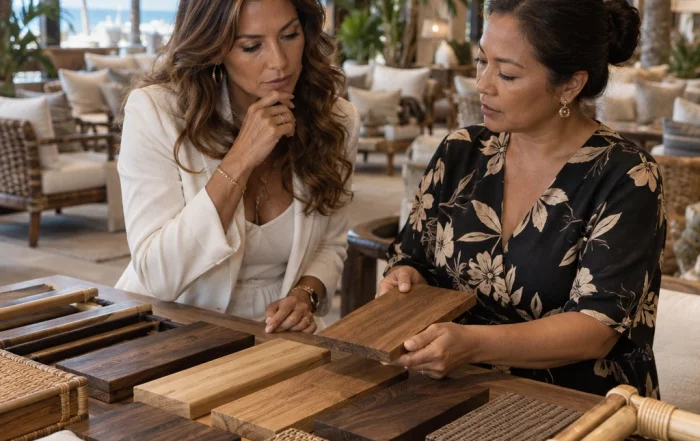
This is one reason color and fabric expertise matters so much in Maui furniture selection. Samples should be reviewed in the actual home, at different times of day, and beside flooring, cabinetry, stone, and exterior views. A whole-home palette may include distinct variations for shaded bedrooms, bright living rooms, covered lanais, and high-traffic entry areas.
Furniture that supports indoor-outdoor living
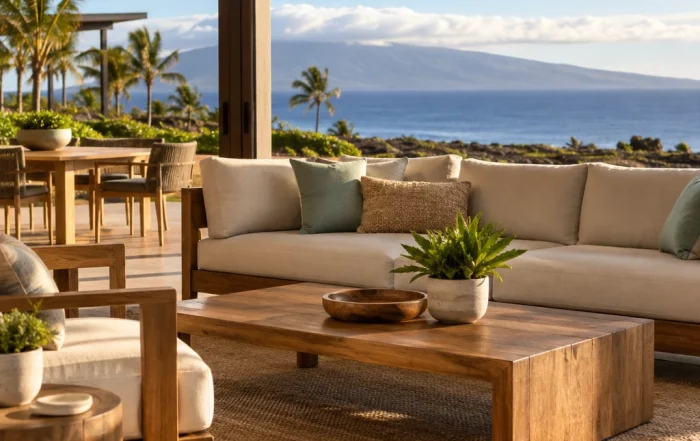
Year-round lanai living blurs the boundary between interior and exterior. The result is a home that needs visual continuity as well as practical durability. A dining table inside may relate to a lanai console through finish or proportion. Accent chairs can echo outdoor textiles without matching exactly. Lighting should create a comfortable transition from daylight to evening entertaining.
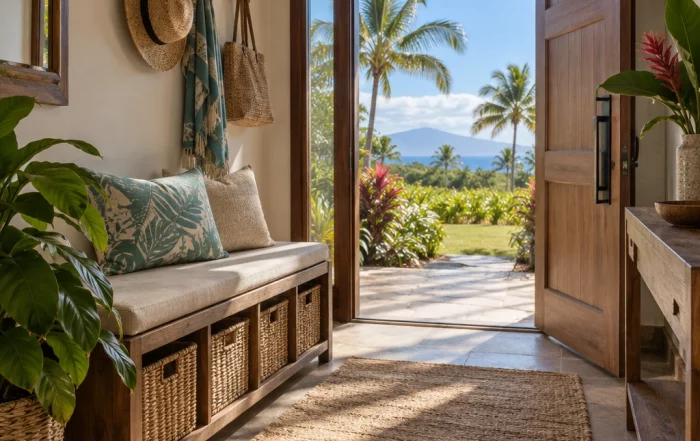
In a rebuilt home, this approach can also make rooms feel larger and more connected. Select fewer, better-proportioned pieces rather than filling every wall. Use benches, stools, nesting tables, and movable accent chairs to give rooms flexibility. In smaller spaces, a well-designed console or storage cabinet can replace several unrelated pieces while keeping the interior organized.
For owners rebuilding a historic or character-rich property, furniture can acknowledge Lahaina’s identity through craftsmanship, local artwork, natural materials, and personal objects. The goal is not to imitate the past, but to create continuity between memory, place, and the future.
Planning Your Maui Wildfire Rebuild Furniture 2026 Project
A successful furnishing project begins with a realistic scope and budget. At IDS Maui, a single-bedroom project may range from approximately $4,000 to $14,000, while a full-house furnishing project can range from $60,000 to $500,000 or more depending on size, brands, customization, rugs, lighting, accessories, and installation requirements.
Before requesting a quote, prepare:
- A floor plan or current construction drawings.
- Room measurements and photographs, if the home is accessible.
- A list of inherited, salvaged, or replacement pieces.
- Your target move-in date and any rental-launch deadline.
- A working budget for furniture, lighting, rugs, freight, installation, and accessories.
- Examples of colors, materials, and rooms you find appealing.
IDS Maui’s design process can include programming, schematic design, design development, construction documentation, construction administration, and purchasing, shipping, and installation. That structure is useful when a project involves architects, contractors, insurance representatives, property managers, and owners who are not always on Maui at the same time.
Clients can also purchase furniture, lighting, rugs, and accessories without commissioning full interior design. IDS represents medium-high to super-high-end manufacturers including Bernhardt, Baker, Caracole, Century, Global Views, Hancock & Moore, Janus et Cie, McGuire, Kravet, Theodore Alexander, and others, with access to lines that may not otherwise be available on Maui.
Conclusion: Build a Home That Is Ready for the Next Chapter
The Maui rebuild has changed the way many homeowners think about interiors. Furniture is no longer an afterthought; it is part of recovery planning, project scheduling, climate response, and personal renewal. The best post-fire home furnishing Hawaii projects balance beauty with performance, flexibility with permanence, and modern convenience with a strong sense of place.
If you are rebuilding in Lahaina, furnishing a new Maui home, or preparing a vacation rental for its next chapter, IDS Maui can help coordinate furniture, lighting, rugs, accessories, custom pieces, freight, and installation. With 27 years of Hawaii-specific experience, IDS understands how island light, salt air, wind, indoor-outdoor living, and remote project management affect design decisions.
Call 808-891-8800 or visit the IDS Maui showroom at 3031 Old Haleakala Highway, Makawao, Monday through Friday from 10 a.m. to 6 p.m. Bring your plans, scope, and budget—and begin creating a rebuilt home that feels durable, personal, and genuinely yours.
Need Help With Your Space?
Ask us anything — furniture, design, or where to start.